Thailand can be both easy and difficult for vegan travelers.
Here’s the short answer: Thailand is one of the best countries in Asia to travel as a vegan – once you know one word (jay – เจ) and the few hidden ingredients to ask about. Koh Phangan and Chiang Mai are vegan heaven. Elsewhere, a little local knowledge goes a long way.
We’ve spent months living, working and eating our way around Thailand – including riding out the COVID-19 lockdown in a Koh Phangan bungalow. This guide is everything I wish I’d known on day one.
Some links in this post are affiliate links – as an Amazon Associate I earn from qualifying purchases, at no extra cost to you.

Table of Contents
Vegan Thailand: Quick Facts
| Word to use | Jay – เจ (sounds like “jay”). It means no animal products at all. |
| Thai word for vegetarian | Mangsawirat – มังสวิรัติ (mung-saw-wee-rat). It means vegetarian, not vegan, so egg and dairy can still be included, and fish sauce can sneak in. |
| Sign to look for | A yellow flag or sign with red เจ lettering |
| Best vegan locations | Koh Phangan and Chiang Mai |
| Local street meal | About 40–80 Baht ($1.20–2.40) |
| Main at a western vegan cafe | About 240–360 Baht ($7–11) |
| Best vegan app | HappyCow (free on Android, a one-off $4.99 on iPhone) |
| Vegetarian Festival | Phuket ran Oct 10–18, 2026. Next is expected Sep 30–Oct 8, 2027 |
| Popular tropical fruit | Mango, papaya, mangosteen, jackfruit, durian |
| Popular vegan ingredients | Tofu, coconut, eggplant, sweet potato, cashew nuts |

Thai Attitudes Towards Veganism
Thai attitudes towards veganism vary between regions. Generally, it’s still seen as a foreign idea, and there are few local vegans.
The big exception is jay food. Many Thai-Chinese Buddhists eat jay on certain days or for the whole Vegetarian Festival, so the concept of plant-only food is well understood – even if the word “vegan” isn’t.
In the country’s vegan hotspots, locals are very conscious of veganism. For example, when ordering tofu fried rice, you’ll often be asked if you want to leave the egg out too.
As you stray further from these vegan destinations, veganism is less understood.
Even in parts of Bangkok, it can be a struggle to order vegan food from street vendors who don’t understand the concept beyond vegetarianism.
In fact, the Thai mentality towards animal treatment is low in general.
Animals, including street dogs, aren’t given the same respect and treatment as in the West.
There’s still a cultural mindset that animals exist for humans – which, unfortunately, is made worse by unconscious western tourism like elephant riding and tiger posing.
Eco-friendly collapsible travel drink bottle.
Jay Food Explained
If you learn one Thai word for your trip, make it jay (เจ).
Jay food comes from Chinese Buddhist and Taoist traditions. It means no meat, fish, eggs or dairy, and no animal-based seasonings like fish sauce, oyster sauce or shrimp paste. That makes it about as close to vegan as Thai food gets.
Traditional jay also leaves out “pungent” vegetables – garlic, onion, shallots, Chinese chives and other strong-smelling alliums. So don’t be surprised if your jay curry tastes a little different.
The Yellow Flag
Look for a yellow flag or sign with red lettering that reads เจ. Sometimes it also shows the Chinese character 齋.
You’ll see these flags year-round at jay restaurants and buffets, especially near Chinese temples and in Bangkok’s Chinatown. During the Vegetarian Festival, they’re everywhere – street stalls, food courts and even 7-Eleven.
Gin Jay and Other Useful Phrases
“Gin jay” (กินเจ) literally means “eat jay”, and it’s the easiest way to explain what you eat. Add khrap (if you’re male) or kha (if you’re female) to the end of any phrase to make it polite.
| English | Thai | Say it like |
|---|---|---|
| I eat jay | ผมกินเจ / ฉันกินเจ | phom (m) / chan (f) gin jay |
| Do you have jay food? | มีอาหารเจไหม | mee ahaan jay mai? |
| No fish sauce | ไม่ใส่น้ำปลา | mai sai nam pla |
| No oyster sauce | ไม่ใส่น้ำมันหอย | mai sai nam man hoi |
| No shrimp paste | ไม่ใส่กะปิ | mai sai kapi |
| No egg | ไม่ใส่ไข่ | mai sai khai |
| No milk | ไม่ใส่นม | mai sai nom |
| Not spicy | ไม่เผ็ด | mai phet |
My tip: screenshot this table or save it in your phone’s notes. Showing the Thai script works far better than my pronunciation ever did.
Hidden Non-Vegan Ingredients
These are the usual suspects in Thai cooking:
- Fish sauce (nam pla) – in almost everything savory, from stir-fries to dipping sauces.
- Oyster sauce (nam man hoi) – common in stir-fried greens and noodle dishes like pad see ew.
- Shrimp paste (kapi) – the base of most curry pastes, including green and red curry.
- Dried shrimp and pla ra (fermented fish) – both go into som tam (papaya salad). Ask for som tam jay.
- Egg – in fried rice, pad thai and some tofu (more on that below).
- Meat or bone stock – in many noodle soups, even “vegetable” ones.
One more warning: mock meat isn’t always vegan. Some contains egg or milk. In 2021, Thailand’s Department of Medical Sciences even found meat DNA in 10 of 57 mock-meat samples it tested. Stick to busy jay restaurants and check labels where you can.
Eating Vegan in Thailand
Whether you want to eat local or international, Thailand has a great range of options – and most of them can be made vegan.
Smartphone apps can be lifesavers in some areas of Thailand. Make sure to check out our recommended vegan travel apps to ensure you’re all set. HappyCow is the one I open first, and Google Translate or Papago’s camera mode is handy for reading labels and menus.

Thai Food
Thailand is a large country. Food culture and certain dishes vary between north and south.
Northern Thai food is influenced by nearby Burmese dishes – Burmese-inspired khao soi tops Culture Trip’s list of the 45 Best Dishes to Eat in Thailand. You’ll find much more sticky rice and spicy curries in the north.
One of my favorite Thai meals is Khao Soi, which is a northern dish that combines crispy and soft noodles in creamy coconut soup. However, in the south, this dish can be extremely difficult to find.
Southern Thai food has more Muslim influence due to its proximity to Malaysia and Indonesia. You’ll eat more fresh fruit and vegetables like mangos and eggplant in meals. Seafood is far more popular in the south.
Unlike in the West, vegans don’t need to worry much about dairy.
Many Thai adults don’t digest lactose well – in one Bangkok study of young Thai adults, about half had lactose malabsorption. It’s common for people of Asian and African origins.
This means Thai food almost never contains cow’s milk and cheese. For the most part, Thai food is cooked with coconut cream and coconut milk instead.
While not used for cooking, cow’s milk is still everywhere in Thailand. Oddly, dairy milk bubble tea is very popular with Thais, despite high rates of lactose intolerance.
The most common non-vegan culprits are fish sauce and eggs, which you’ll want to ask them to leave out.
Shockingly, Thai tofu can sometimes contain eggs. In my experience this is rare, and it’s easy to tell the difference from appearance and taste. Egg tofu is usually round and has a thicker texture, whereas vegan tofu is cut into square cubes and has a soft inner texture.
Common Vegan Substitutes:
- Meat replacement: Tofu and/or cashew nuts
- Fish sauce: Soy sauce
- Dairy milk: Coconut milk
Local Meals Easily Made Vegan:
- Thai green curry (ask for a curry paste without shrimp paste)
- Tofu fried rice
- Pad thai
- Khao soi
- Massaman curry
- Mango sticky rice

Thai restaurants won’t always advertise vegetarian alternatives. However, more often than not they’re happy to adjust their menu. You just need to ask.
On a side note, breakfast is notoriously the most difficult Thai meal to make vegan.
International Food in Thailand
In Thailand, you’re never far from Indian and Middle Eastern restaurants – two staples for vegan-friendly food.
The Indian food in Thailand is generally affordable and tastes as close as you can get to authentic Indian without crossing the Bay of Bengal. Not sure what to order? Here are 15 Indian dishes that are vegan or easy to veganize.
In fact, Chana Masala in Koh Phangan serves some of the most delicious vegan Indian food I’ve ever had.
Unfortunately, Mexican food generally misses the mark in Thailand.
International Foods Ranked for Vegans
| Indian – 9/10 | Some of the best Indian food outside of South Asia. |
| Arabic – 8/10 | Thailand serves up some delicious vegan Arabic food. While quality can vary, most Middle Eastern dishes will be winners. |
| Italian – 6/10 | Pizza is hit or miss in Thailand, especially vegan pizza. In vegan hotspots like Koh Phangan, you can find amazing vegan pizza. But generally, Thai pizza doesn’t hit the mark. |
| Mexican – 1/10 | It’s extremely difficult to find good, authentic Mexican food in Thailand. |
Street Food Survival Tips
Street food is a way of life in Thailand. There’s nothing quite like walking through the smoky side streets of Bangkok to the smell of food cooking on open grills and the ramble of locals chatting on plastic child-size seating.
There’s something special about sifting through bustling night markets, grabbing cheap finger food as you go. And there’s no reason why vegans need to miss out.

Eating Thai Street Food as a Vegan
Thai street food is usually a section of the street that’s been taken over by small local vendors, each selling a specific food or meal.
Sometimes you’ll find larger restaurants on the street, but for the most part, each stall specializes in cooking one type of meal.
These foods are either vegan or can be made vegan on request:
- Fried rice
- Pad thai
- Pad see ew (ask for no oyster sauce)
- Mushroom tom kha
- Mango sticky rice
- Tofu sticks
Pros of Street Food for Vegans
- You’re not limited to one menu
- You can see your food being cooked
- Food is extremely cheap – usually 40–80 Baht ($1.20–2.40) a dish, more in tourist areas
Cons of Street Food for Vegans
- Generally, street food needs to be altered to make it vegan
- Local street food vendors don’t always understand English – this is where the phrase table above earns its keep
- Sauces and curry pastes are often made in advance, so “no fish sauce” isn’t always possible

Vegan Eats at Thai Night Markets
Every Thai night market is different, but I haven’t been to one I can’t eat at until my heart’s content.
Some of the popular vegan options found at night markets are:
- Spring rolls
- Sweet potato balls
- Coconut pancakes
- Falafel
- Sushi rolls
- Samosas
- Mango sticky rice
- Tofu and veggie sticks
The list goes on, but you get the idea.
Thailand’s Vegan Hotspots
Thailand has some of the world’s leading vegan hotspots spread out across the country.
These vegan hotspots are popular with long-term expats, yoga retreats and digital nomads.
Koh Phangan
Located in the Gulf of Thailand, Koh Phangan is a small island about a 30-minute ferry ride from Koh Samui.
While the island is known for hosting infamous full moon parties, there’s another side to Koh Phangan that’s less known – it’s a vegan paradise.
A spiritual community of expats and digital nomads has formed in the north of the island, creating an abundance of yoga centers, meditation retreats and, best of all, the greatest vegan food in Thailand.
Find our Koh Phangan digital nomad guide here. Between meals, check out the best beaches in Koh Phangan, our Koh Phangan gyms guide and our ultimate list of 50 things to do in Koh Phangan.

Eat.co
- Location: Sri Thanu, Koh Phangan
- Price: Mains and bowls around 240–360 Baht ($7–11)
- Fully vegan
- Top pick: The breakfast menu – that’s where my photo above is from
- Last checked: October 2026 (open daily 8:30am–10:30pm, per its own site)
Chana Masala
- Location: Hin Kong, Koh Phangan
- Vegan-friendly (vegetarian Indian with plenty of vegan dishes)
- Top pick: The vegan thali set
- Last checked: October 2026
- Also on Instagram.
[Closed] Aree’s Vegan Buffet
Sadly, Aree’s has closed. It was one of our favorite spots on the island.
The incredible vegan options are endless in Koh Phangan. I wrote a full vegan guide to Koh Phangan here.
Most travelers base themselves in Thong Sala or Sri Thanu, and both have plenty of places to stay.

Chiang Mai
Nestled in the northern mountains, Chiang Mai feels a world away from the sun-soaked southern islands. But what it lacks in beaches, it makes up for in culture, luscious landscapes and a delicious vegan food scene.
Chiang Mai boomed into one of the digital nomad hubs of the world. Remote workers flooded to the northern city, which brought a rise of stylish coworking spaces, modern cafes and world-class plant-based restaurants. It’s no surprise Chiang Mai made our list of the best cities in Asia for vegans.
Most of the vegan spots are in or around the Old City, so you can walk between them. It’s also the best place in Thailand to take a vegan cooking class (more on that below).

Reform Kafé
- Location: Inside Green Tiger House, Sri Poom Road Soi 7, Old City
- Price: Mains around 160–220 Baht ($4.75–6.50)
- Fully vegan
- Last checked: October 2026 (open daily – its website lists different hours on different pages, so check before you go)
Cat House
- Location: Chaiyapoom Soi 1, near Tha Phae Gate
- Vegan-friendly (not fully vegan – check what you order)
- Top pick: The Burmese tea leaf salad gets a lot of love
- Last checked: October 2026
Pure Vegan Heaven
- Location: Rachadamnoen Soi 8, Old City
- Price: Most dishes around 130–200 Baht ($3.85–5.90)
- Fully vegan
- Last checked: October 2026 (the Old City branch is open; its second branch at Freeative closed in July 2025)
If you want to be close to spots like this, stay in or near the Old City.
Pai
Chiang Mai’s northern neighbor, Pai is a small town with a big hippie feel.
Unlike Koh Phangan and Chiang Mai, Pai tends to attract more short-term visitors and backpackers.
The laid-back town has lots to offer and some tasty vegan eats too. Most of the cafes below are daytime spots, so plan dinner elsewhere.
Bom Bowls
- Location: Mae Hee, just outside town
- Price: Smoothie bowls around 120–140 Baht ($3.55–4.15)
- Fully vegan (cash only)
- Last checked: October 2026 (daytime only, roughly 8:30am–4pm; some listings say it closes on Tuesdays, so check its Facebook page)
Earth Tone
- Location: Pai
- Price: One of Pai’s pricier cafes
- Fully vegan
- Last checked: October 2026 (roughly 9am–4:30pm; most listings say it’s closed on Saturdays)
Charlie & Lek
- Location: Rangsiyanon Road, Pai
- Price: Budget-friendly
- Vegan-friendly
- Last checked: October 2026 (11am–8:30pm, closed Sundays)
Pai is small and walkable, so anywhere near the walking street puts you close to the food.
Veganism in Bangkok
Bangkok is a bustling cosmopolitan city with an endless array of things to keep you busy.
As the main gateway in and out of Thailand, you’ll likely spend some time in this vibrant city.
But Bangkok tends to divide vegan travelers, including me. Despite visiting Bangkok multiple times, I’m still torn as to whether or not I consider it a good vegan destination.
While there are delicious vegan restaurants, they’re few and far between and more expensive than in other regions of Thailand.
On top of that, Bangkok’s iconic street food seems harder to “veganize,” with vendors limited on simple vegan ingredients like tofu.
The one big exception is Chinatown (Yaowarat) during the Vegetarian Festival, when the main road fills with yellow-flag jay stalls for nine days.
You can read my review of Bangkok’s leading vegan restaurants, Vistro and Broccoli Revolution, here. Both were still open as of October 2026 – Broccoli Revolution now has two branches, on Sukhumvit 49 and Charoen Krung.

Vegan Snacks and 7-Eleven
Thailand has lots of vegan snack options between food stands, 7-Elevens and supermarkets.
For the most part, supermarket snacks are similar to those in the West – fruit, nuts, chips and Oreos.
7-Eleven products vary from store to store. Year-round, look for soy milk, nuts, fruit, seaweed snacks and the odd jay ready meal, bun or instant noodle. Look for the jay symbol on the pack, or point your phone’s translate app at the label.
During the Vegetarian Festival, it’s a different story – in 2025, 7-Eleven stocked more than 300 jay items.
I’m still waiting for the day I see a vegan cheese toasty in 7-Eleven.
You can also check out our list of the best vegan travel snacks.

Cooking in Thailand
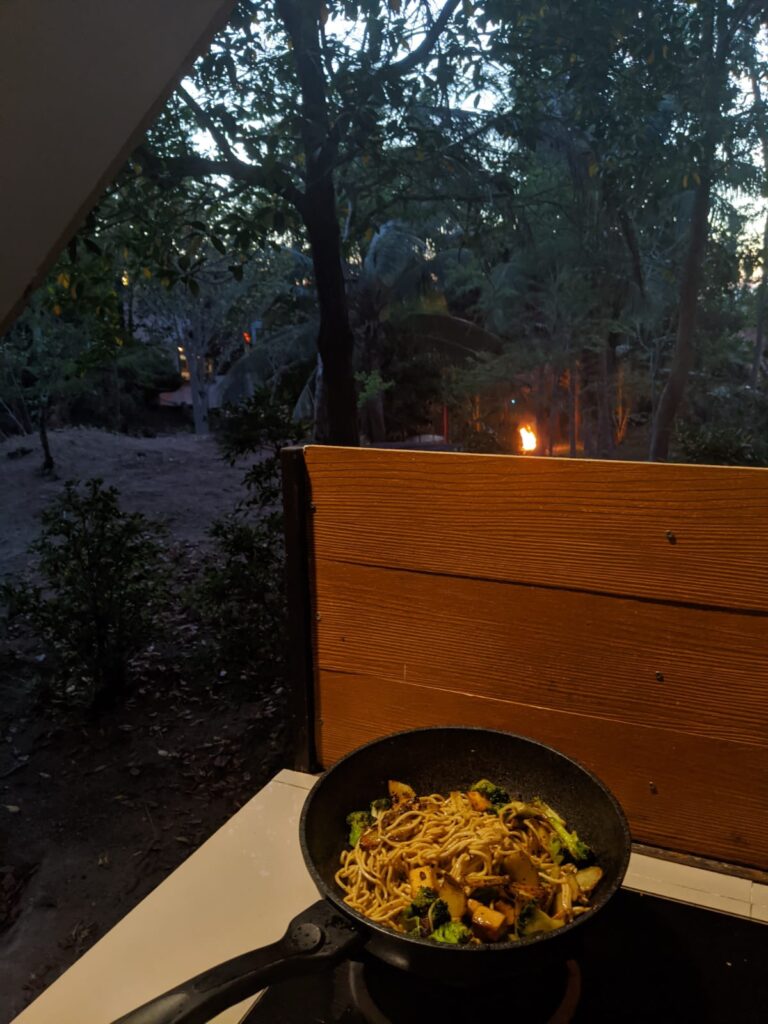
Cooking in Thailand is generally more expensive than eating out, so I usually avoid it. However, I was locked down in Thailand during the COVID-19 pandemic, which meant lots of home cooking from my Koh Phangan bungalow during months of quarantine.
Thai Kitchens
If you’re staying in Thailand long-term, you’ll likely have your own kitchen and be able to cook for yourself.
In all my time staying in Thailand, I’ve yet to have a kitchen with an oven, so baking is off the menu.
Thai kitchens most commonly have open-flame stoves, so frying and boiling is the way to go.
Vegan Food in Supermarkets
Thailand has a good range of supermarkets where you can get many things available in western countries.
Thailand’s best supermarkets are:
- Makro
- Big C
- Lotus’s (formerly Tesco Lotus – it was renamed in 2021)
Thai supermarkets are good for vegan options like plant-based milk, vegan cheese, oats and so much more. I personally prefer Makro for vegan food, but Big C and Lotus’s also have good options.
Don’t buy fruit and veggies at these supermarkets – you’ll find far better deals at local markets.
Vegan Cooking Classes
It’s no surprise cooking classes are popular in Thailand.
Vegan cooking classes are springing up everywhere in Thailand, especially in Chiang Mai. Here are some popular vegan cooking classes:
- May Kaidee’s Cooking School – Chiang Mai and Bangkok
- Baan Farm Cooking School – Chiang Mai (not fully vegan, but it adapts dishes for vegans – tell them when you book)
If you’re taking a class with a non-vegan cooking school, make sure they can provide vegan cooking options – and ask about the curry paste, which usually contains shrimp paste.
Vegan Tourism
While Thailand’s vegan food options have come on leaps and bounds, the poor treatment of animals for profit has a long way to go.
This is made worse by common unethical tourism practices like elephant riding, tiger posing and zoo tourism.

Elephant Tourism in Thailand
Elephant riding is an extremely cruel industry.
Elephants used for tourism have historically been taken from the wild and away from their herds in violent and disturbing ways. Today, many are bred in captivity to supply the industry.
Naturally, elephants are opposed to humans climbing on their backs. So, in order for humans to ride them, young elephants are beaten over and over again until their spirit is “broken.” This process is hauntingly called the “crush.”
You’ve probably heard the saying “elephants never forget.” Their long memories mean they live in fear of their captors and humans.
Retirement isn’t guaranteed either. Many tourism elephants are worked for most of their lives.
The solution is simple. If tourists stop riding elephants, the violent cycle will end.
Ethical Elephant Tourism
While Thailand’s elephant tourism is mostly cruel, there are ways you can experience elephants in an ethical and more rewarding way.
After all, looking into an elephant’s eyes is a far more intimate experience than riding on its back.
There are a number of elephant sanctuaries in Thailand with an emphasis on conservation and rehabilitation of rescued elephants.
Tours are available where guests can help clean and feed the animals. The sanctuaries often need volunteers too, where you can get a more personal experience with the gentle giants.
Animal Sanctuaries
No matter where you go in Thailand, there are animals in need.
Animal sanctuaries are packed with injured street dogs, cats and other animals needing support. The sanctuaries are mostly non-profit and rely on the good nature of humans who care.
Volunteering will be some of the most rewarding experiences of your Thailand trip.
Find a list of animal sanctuaries here.

Thailand’s Vegetarian Festival
The Thai Vegetarian Festival, or Nine Emperor Gods Festival (known in Thai as thetsakan gin jay), is a nine-day jay festival held at the start of the ninth month of the Chinese lunar calendar. Despite the name, the food is jay – so it’s closer to vegan than vegetarian.
While the festival is filled with flavorful vegan food, the carnival-style event features some extremely shocking sights – spirit mediums piercing their cheeks with swords and skewers.
The festival originated in China, but it’s widely celebrated by Thais all around the country. The biggest celebrations are held in Phuket, and Bangkok’s Chinatown (Yaowarat) turns into one long jay food market.
- 2026: Phuket ran October 10–18, 2026.
- 2027: Expected September 30 – October 8, 2027 (the dates move each year with the lunar calendar).
Two tips if you go: wear white with long sleeves and closed shoes because of the firecrackers, and still check labels on mock meat – not all of it is as plant-based as it claims (see the mock-meat warning above).
Heading to Thailand? Grab a copy of Lonely Planet’s guide to Thailand on Amazon.
Vegan Thailand FAQs
Is Thailand good for vegans?
Yes. Koh Phangan and Chiang Mai are two of the best places for vegans in Asia, and jay food means almost every town has some plant-only options. Outside the hotspots, you’ll need a few Thai phrases and some patience.
How do you say vegan in Thai?
The most useful word is jay (เจ), which means plant-only food with no animal ingredients. Thais also use the English loanword วีแกน (“vee-gan”), mostly in cities. Mangsawirat (มังสวิรัติ) means vegetarian, so egg and dairy may still be included – and it’s worth double-checking for fish sauce.
Is Thai food vegan?
Not usually as served. Fish sauce, oyster sauce, shrimp paste and egg are in many dishes, and most green and red curry pastes contain shrimp paste (kapi). But most Thai dishes can be made vegan if you ask for them jay or without those ingredients.
What can vegans eat at 7-Eleven in Thailand?
Soy milk, nuts, fruit, seaweed snacks, and some jay ready meals, buns and instant noodles. The range grows hugely during the Vegetarian Festival. Look for the jay symbol on the label.
When is the Vegetarian Festival in Thailand?
It runs for nine days at the start of the ninth Chinese lunar month. In 2026 it ran October 10–18 in Phuket. In 2027 it’s expected September 30 – October 8.
Where is the best vegan food in Thailand?
Koh Phangan, followed closely by Chiang Mai. Pai has a small but good scene, and Bangkok has great restaurants if you’re willing to travel across the city for them.
Final Thoughts
Thailand can feel tricky at first, but once you know to ask for jay and to skip the fish sauce, it becomes one of the easiest – and tastiest – places in the world to travel as a vegan.
Head for Koh Phangan or Chiang Mai if you want vegan food on every corner. Save this guide’s phrase table to your phone. And please, skip the elephant rides.
Spending time on the islands? Our Koh Phangan vegan food guide has every spot we love, and if you’re tempted by a souvenir that lasts, read our guide to getting a bamboo tattoo in Thailand.
Did we miss your favorite vegan spot in Thailand? Let us know in the comments!


